1

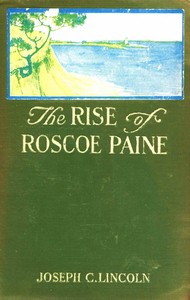
The Rise of Roscoe Paine — Edition Insights
(0 User reviews)
47
Project Gutenberg
2006
Not confirmed
Massachusetts -- Fiction; Cape Cod (Mass.) -- Fiction
Readers of public-domain and historical texts
Project Gutenberg digital edition
en
Edition facts
Words
138,645
Reading time
603 min
Text sections
16
Before opening The Rise of Roscoe Paine — Edition Insights, the edition data offers a quick orientation: 138,645 words, 10 hr 3 min estimated reading time, and 16 detected text sections.
The text analysis averages about 10.7 words per sentence, while the detected sections provide another way to judge how the source is divided.
Project Gutenberg metadata also associates the work with “Massachusetts -- Fiction,” connecting these edition facts with the source record’s subject description.
Source:
Project Gutenberg record #3137
An editorial note on Joseph C. Lincoln's novel, focusing on its structure, recurring images, and movement between scenes, with observations drawn from the opening chapter and later excerpts.
Editorial Edition Score
4.8/5
★★★★★
★★★★★
Calculated from edition completeness, EPUB availability, text structure and catalogue metadata. Not a user rating.
How this score is calculated
- Description quality20 pts
- Title & short description10 pts
- Source metadata20 pts
- Text length15 pts
- Chapters / structure15 pts
- EPUB file integrity20 pts
Total of 100 points, scaled to a 2.5-5.0 range. Editions with an empty description or a missing EPUB file are not scored.
Edition quality
Public-domain source text
Read the source text
The source text is kept in the dedicated reader, separate from this catalogue record and its commentary.
The novel opens with a deceptively simple domestic scene: Roscoe Paine tells Dorinda he is going for a walk, and her repeated "Um-hm" becomes a barometer of disapproval, shifting from Labrador to Greenland as the conversation unfolds. This early attention to a single word, its tonal variations, and the narrator's commentary on it establishes a voice that is both self-aware and wryly observant. The structure of the book, as hinted by the table of contents, moves through twenty-four chapters, but the excerpts suggest a narrative that oscillates between interior reflection and external dialogue, often within the same paragraph.
The Weight of a Single Syllable
The opening chapter hinges on Dorinda's "Um-hm," a word that the narrator explicitly glosses as good Scotch for "yes" but which, in Dorinda's usage, carries a full spectrum of meaning. The narrator compares her utterances to temperatures from the Equator to the North Pole, and within a few lines, he tracks her "Um-hm" moving "along the northern edge of Labrador" and then "crossing over to Greenland." This is not mere whimsy; it is a structural device that signals how much of the novel's tension will be carried by implication, tone, and what is left unsaid. The narrator's habit of parsing such small signals recurs throughout the excerpts, as when he later interprets Captain Dean's grim smile or the "knowin'" look of Elnathan Mullet. The reader is trained to attend to these micro-expressions, which often carry more weight than the spoken words.
Thresholds and Transitions
The movement between scenes in the excerpts is frequently marked by physical thresholds: doors, railings, settees. Roscoe takes his cap from behind the dining-room door, opens the outside door, turns the corner of the house, and later steps outside the railing to sit with Captain Dean. Each crossing from interior to exterior, or from one conversational space to another, coincides with a shift in the social or emotional register. The warm spring sunshine pouring in contrasts with the "glacier" of Dorinda's mood; the settee by the wall becomes a semi-private zone for whispered schemes. This pattern suggests a novel that uses architecture and landscape as coordinates for its emotional geography, with the Shore Lane itself—a contested piece of land—serving as the ultimate threshold between private interest and public good.
The Economics of Voice
Captain Dean's speech in the later excerpt reveals a recurring concern: the relationship between money and integrity. He insists there are things he would not sell—his daughter's happiness, his Selectman's job—yet he has just admitted to lying. The narrator, Roscoe, draws a parallel between Dean and Mr. Colton, both of whom are driven by a desire to "show 'em." This conversation is immediately followed by Dean's whispered proposal that Roscoe sell his land to a development company, not to Colton, as a way to "put a reef under His Majesty's bows." The language of commerce—"offer," "sell," "prices," "development"—permeates the dialogue, but it is always inflected by personal rivalry and local politics. The novel seems to treat economic transactions as a kind of speech act, where every offer or refusal carries a subtext of loyalty, revenge, or pride.
Rumor as Narrative Engine
Captain Dean's information about the Bay Shore Development Company arrives not as a direct report but as "talk driftin' 'round," passed from Alvin Baker to an unnamed "feller" to another "somebody." The chain of hearsay is explicitly traced, and the source remains vague—"It just seems to be in the air." This reliance on rumor as a plot mechanism is notable: the novel's conflicts are often propelled not by events that the narrator witnesses but by stories that circulate through the community. Elnathan Mullet's shut mouth, Dean's knowing look, and the general excitement in Ostable all create a texture of uncertainty. The reader, like Roscoe, must piece together intentions from fragments. This structural choice keeps the focus on interpretation and suspicion rather than on direct action, at least in the passages available.
Readers attentive to the novel's use of space and silence will find that the excerpts reward close attention to how characters enter and leave rooms, how they pause before speaking, and how they repeat or withhold words. The Shore Lane, though not yet described in detail, already functions as a symbolic crossroads where personal desire, community need, and speculative capital converge. The narrative voice, with its dry humor and habit of glossing local speech, invites the reader to become a fellow interpreter of Cape Cod's social codes.
Reading the editorial notes on The Rise of Roscoe Paine, I kept thinking about the quiet, unhurried way coastal towns hold their secrets. That same patient unfolding, scene by scene, reminded me of an old volume I once found, Murad the Unlucky, and Other Tales — Inside the Classic, where each story felt like a tide pool revealing itself slowly, without hurry or demand.
There are no reviews for this eBook.
There are no comments for this eBook.
Reader reflection
Before you leave, reflect on the book
Use these questions to collect your thoughts before moving on.
Your progress
0
/
10
2
Did this book hold your interest?
3
Is this a title you would suggest to others?
4
Did the language feel accessible?
5
Did the book give you something worth debating?
6
Was the book easy to understand?
7
How original did the book feel?
8
Did any part of the book stay with you emotionally?
9
Which lesson or insight stayed with you?
10