1

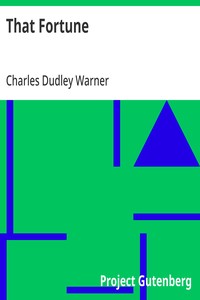
That Fortune — A Closer Reading
(0 User reviews)
269
Project Gutenberg
2004
Not confirmed
American fiction -- 19th century
Readers of public-domain and historical texts
Project Gutenberg digital edition
en
Edition facts
Words
90,188
Reading time
393 min
Text sections
10
That Fortune — A Closer Reading can be approached with a clearer sense of reading commitment from its source measurements: 90,188 words, 6 hr 33 min estimated reading time, and 10 detected text sections.
The text analysis averages about 17.5 words per sentence, while the detected sections provide another way to judge how the source is divided.
Project Gutenberg metadata also associates the work with “American fiction -- 19th century,” connecting these edition facts with the source record’s subject description.
Source:
Project Gutenberg record #3105
This editorial note examines Charles Dudley Warner's authorial choices in diction, dialogue, and description, focusing on the opening scene's sensory language and the contrasting voices of the Mavick family to reveal character and social critique.
Editorial Edition Score
4.8/5
★★★★★
★★★★★
Calculated from edition completeness, EPUB availability, text structure and catalogue metadata. Not a user rating.
How this score is calculated
- Description quality20 pts
- Title & short description10 pts
- Source metadata20 pts
- Text length15 pts
- Chapters / structure15 pts
- EPUB file integrity20 pts
Total of 100 points, scaled to a 2.5-5.0 range. Editions with an empty description or a missing EPUB file are not scored.
Edition quality
Public-domain source text
Read the source text
The source text is kept in the dedicated reader, separate from this catalogue record and its commentary.
Charles Dudley Warner opens That Fortune with a twelve-year-old boy swinging in a hickory tree, a scene dense with sensory detail: the “amber river,” the “loud, unceasing murmur,” and the boy’s “lithe and tough” perch. The prose rhythm mimics the swaying motion, and the narrator’s speculative aside—“it might be that in that moment ambition was born”—invites readers to consider how setting shapes character. This is not mere scene-setting; it establishes a pattern of using natural imagery to reflect inner states, a technique Warner sustains through the novel.
Diction and the Natural World
Warner’s word choices in the opening chapter are notably precise and evocative. He describes the boy’s companions as “the elegant gray squirrel and the lively red squirrel and the comical chipmunk,” each adjective doing double duty: “elegant” suggests grace, “lively” energy, “comical” a touch of humor. The boy himself is “idly and recklessly swinging,” a pairing that hints at both freedom and danger. The narrator’s vocabulary shifts when describing the landscape: “stately chestnuts,” “amber river,” “wooded dome of Mount Peak.” These terms carry a formal, almost reverent tone, contrasting with the colloquial directness of the boy’s imagined reply—“To see the world.” This juxtaposition of registers—lyrical description versus plain speech—marks a key authorial strategy: Warner uses elevated diction to convey the boy’s unspoken wonder, while reserving simpler language for dialogue and internal thought.
Dialogue as Revealer of Social Position
In later excerpts, dialogue becomes a tool for exposing class and power dynamics. When Mrs. Mavick “enlightens” Evelyn about her expectations, the mother’s speech is laced with terms like “worldly ambition” and “career,” revealing her own values. Evelyn’s responses, by contrast, are described indirectly: she “did not care much for the things that she herself cared most for.” Warner avoids direct quotation here, instead filtering Evelyn’s thoughts through free indirect discourse. The effect is to align the reader with Evelyn’s perspective while keeping Mrs. Mavick’s voice at a distance. The narrator’s comment that Carmen found Evelyn “a little perverse” is tinged with irony, as the mother’s disappointment underscores her materialism. Warner’s dialogue thus serves not just to advance plot but to dramatize a clash of worldviews, with each character’s word choices—or their absence—marking their place in the social hierarchy.
Description of Interiority and Restraint
Warner’s descriptive passages often focus on what characters do not say or feel. Evelyn’s childhood is summarized as a time when she “became conscious that she was never alone,” a phrase that conveys confinement without melodrama. The narrator notes that “it was not until very recently that it could be explained to her, without putting her in terror hourly, why she must always be watched.” This restraint—the withholding of explicit explanation—mirrors Evelyn’s own guardedness. Similarly, the description of Mr. Mavick as a “great power in the world” but not a “general or a statesman or an orator” uses negation to define him by what he is not. Warner’s descriptive strategy is cumulative: he builds character through small, precise observations rather than grand pronouncements, trusting readers to infer the emotional weight beneath the surface.
Structure and the Shifting Narrative Lens
The novel’s structure, as glimpsed in these excerpts, alternates between a close third-person focus on the boy (later revealed as Philip) and a more omniscient view of the Mavick household. The opening chapter is almost entirely internal, with the narrator venturing into the boy’s mind: “Nature was taking him by the hand, and it might be that in that moment ambition was born.” This speculative tone—using “might be” and “perhaps”—creates intimacy while acknowledging the limits of knowledge. In contrast, the later sections on Evelyn adopt a more analytical voice, summarizing her education and her mother’s “chagrin.” The shift in narrative distance is deliberate: the boy’s world is rendered with sensory immediacy, while Evelyn’s is filtered through social commentary. Warner thus uses structural variation to mirror the characters’ different relationships to freedom and constraint, with the boy’s open landscape giving way to the heiress’s guarded interior.
Readers attentive to Warner’s craft will notice how he embeds social critique in seemingly neutral description. The contrast between the boy’s “free creature” swinging and Evelyn’s “guarded life” is not accidental; it is built into the novel’s very language. Pay attention to moments when the narrator steps back with a qualifying phrase—“it might be,” “perhaps,” “as little as”—for these are where Warner signals the complexity of his characters’ inner lives without overexplaining.
I’ve shelved both editions for decades, and That Fortune’s sharp-edged drawing-room chatter always reminds me of the quiet homesickness threading through Back Home — A Closer Reading. One watches society’s masks; the other, the ache beneath them. They sit apart on the shelf, yet whisper the same tenderness to anyone who listens closely.
There are no reviews for this eBook.
There are no comments for this eBook.
Reader reflection
Record your reading impressions
A brief reflection can help important ideas stay with you longer.
Your progress
0
/
10
2
What was your overall reaction to the book?
3
Is this a title you would suggest to others?
4
How easy was the book to follow?
5
How much did the book move you?
6
Did the book give you something worth debating?
7
How distinctive were its ideas or approach?
8
What was the strongest part of the book?
9
What did this book teach you most?
10