1

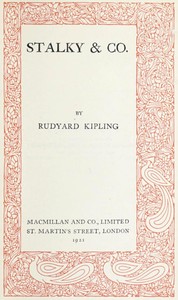
Stalky & Co. — Context and Discussion
(0 User reviews)
377
Project Gutenberg
2002
Not confirmed
Schools -- Fiction
Readers of public-domain and historical texts
Project Gutenberg digital edition
en
Edition facts
Words
72,409
Reading time
315 min
Text sections
8
The source record for Stalky & Co. — Context and Discussion measures this digital text at 72,409 words, 5 hr 15 min estimated reading time, and 8 detected text sections.
The text analysis averages about 12.3 words per sentence, while the detected sections provide another way to judge how the source is divided.
Project Gutenberg metadata also associates the work with “Schools -- Fiction,” connecting these edition facts with the source record’s subject description.
Source:
Project Gutenberg record #3006
Kipling's school stories follow Stalky, McTurk, and Beetle through forbidden hut-building, mock fights, and strategic pranks, using precise dialogue and ritualized conflict to expose the unofficial codes of a Victorian boys' boarding school.
Editorial Edition Score
4.7/5
★★★★★
★★★★★
Calculated from edition completeness, EPUB availability, text structure and catalogue metadata. Not a user rating.
How this score is calculated
- Description quality20 pts
- Title & short description10 pts
- Source metadata20 pts
- Text length15 pts
- Chapters / structure15 pts
- EPUB file integrity20 pts
Total of 100 points, scaled to a 2.5-5.0 range. Editions with an empty description or a missing EPUB file are not scored.
Edition quality
Public-domain source text
Read the source text
The source text is kept in the dedicated reader, separate from this catalogue record and its commentary.
The first chapter, “In Ambush,” opens with the three protagonists building a forbidden hut in the furze-hill, a detail that immediately establishes the central tension between rule-breaking and ingenuity. Kipling’s narration is brisk and ironic, noting that the boys “smoked” in their retreat—a small but telling transgression. The excerpt shows Stalky orchestrating a mock fight to trap two older boys, Sefton and Campbell, into participating. The dialogue is rapid and colloquial, with Stalky using terms like “oratio obliqua” and referencing Galton’s “Art of Travel” to justify tying Beetle up as a “sacrifice.” This blend of classical allusion and practical cunning is a hallmark of the trio’s method.
The War Dance of Stalky
One of the most distinctive recurring details in the excerpts is Stalky’s physical ritual before executing a plan. When he “drove his hands into his pockets and stared out of window at the sea, whistling between his teeth,” then “began the short quick double-shuffle—the war-dance of Stalky in meditation,” Kipling gives the reader a clear visual cue that a scheme is forming. The dance is described with precise steps: “thrice he crossed the empty form-room, with compressed lips and expanded nostrils, swaying to the quick-step.” This is not mere fidgeting; it is a deliberate, almost theatrical preparation. The narrator treats it with deadpan seriousness, which contrasts with the absurdity of the boys’ plots. Readers should watch for this dance in later chapters—it signals that Stalky is shifting from idle mischief to calculated action.
The Art of the Mock Fight
The excerpt from “In Ambush” contains a carefully staged mock fight that reveals the trio’s skill in manipulating appearances. Beetle is trussed for cock-fighting with a stump between elbow and knee and his knees bound with a box-rope. Stalky instructs him to “blub” and to remember “the bleatin’ of the kid,” referencing Galton’s travel book to frame the deception as a lesson in natural history. The performance is layered: Beetle’s protest—“You’ve nearly cut my knees off. Oh, you are beastly cads!”—is described as “a work of art” in tone. The bait works: Sefton and Campbell enter, eager to join the cruelty. Kipling does not moralize; he simply records the mechanics of the trick. This scene exemplifies how the boys use theatrical violence to achieve social ends, a pattern that likely recurs throughout the book.
Voice and Colloquial Rhythm
Kipling’s dialogue is dense with period slang and clipped phrasing that gives each boy a distinct voice. Stalky speaks in short, commanding bursts: “Rot! What are you goin’ to do?” and “I like oratio obliqua.” McTurk’s lines are more aggressive, as when he roars, “Roll up, Beetle, or I’ll kick you into the fender.” Beetle, the would-be writer, produces elaborate protests that are “a work of art.” The narrator also uses a dry, understated tone—for example, noting that the boys “had built like beavers a place of retreat and meditation, where they smoked.” This combination of vernacular speech and ironic narration creates a texture that rewards close attention. Readers should note how the boys’ language shifts between formal schoolboy jargon and raw insults, reflecting their dual roles as scholars and rebels.
The Role of the School Sergeant
Early in the excerpt, the narrator introduces Foxy, “the subtle red-haired school Sergeant,” whose job is to enforce rules and whose distrust of the trio is established immediately. He “did not trust them,” and his presence looms as a counterweight to the boys’ freedom. The hut-building is “strictly forbidden,” and Foxy’s role is to detect such infractions. This sets up a cat-and-mouse dynamic that likely runs through the book. The excerpts do not show a direct confrontation with Foxy, but his mention signals that the boys’ schemes operate within a system of surveillance. Readers should pay attention to how the trio evades or outwits authority figures like Foxy and Mr. Prout, as these encounters probably structure the episodic plot.
These excerpts suggest that Stalky & Co. rewards readers who attend to small physical and verbal details—the war-dance, the mock fight choreography, the precise slang. Kipling does not explain the boys’ motives; he shows them in action. A first-time reader should treat each chapter as a self-contained puzzle, watching how the trio’s rituals and alliances shift. The book’s episodic structure means that earlier scenes, like the ambush in the furze-hill, establish patterns that later chapters may invert or complicate.
There’s something about the way those boys build their own quiet world, all loyalty and unspoken rules, that stays with you after the last page. It made me think of the measured tenderness in To Have and to Hold — Themes and Context, where restraint carries so much weight. Both feel less like stories and more like old, familiar rooms you keep revisiting.
There are no reviews for this eBook.
There are no comments for this eBook.
Reader reflection
Before you leave, reflect on the book
Use these questions to collect your thoughts before moving on.
Your progress
0
/
10
2
How much did you enjoy the reading experience?
3
Would you recommend this book to another reader?
4
What was the reading difficulty like?
5
Which element worked best for you?
6
Would a second reading be valuable?
7
Did the book give you something worth debating?
8
How did the reading compare with what you expected?
9
In one sentence, what did you learn?
10