1

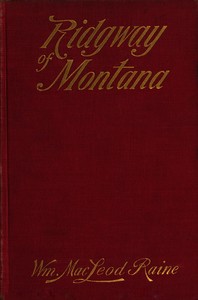
Ridgway of Montana: A story of to-day, in which the hero is also the villain — Edition Insights
(0 User reviews)
44
Project Gutenberg
2000
Not confirmed
Western stories; Montana -- Fiction
Readers of public-domain and historical texts
Project Gutenberg digital edition
en
Edition facts
Words
67,571
Reading time
294 min
Text sections
28
For Ridgway of Montana: A story of to-day, in which the hero is also the villain — Edition Insights, the stored edition analysis reports 67,571 words, 4 hr 54 min estimated reading time, and 28 detected text sections.
The text analysis averages about 14.1 words per sentence, while the detected sections provide another way to judge how the source is divided.
Project Gutenberg metadata also associates the work with “Western stories,” connecting these edition facts with the source record’s subject description.
Source:
Project Gutenberg record #2285
An editorial note on William MacLeod Raine's 'Ridgway of Montana,' focusing on the author's choices in diction, dialogue, and description, particularly the portrayal of a hero-villain and the use of ironic, analytical conversations.
Editorial Edition Score
4.8/5
★★★★★
★★★★★
Calculated from edition completeness, EPUB availability, text structure and catalogue metadata. Not a user rating.
How this score is calculated
- Description quality20 pts
- Title & short description10 pts
- Source metadata20 pts
- Text length15 pts
- Chapters / structure15 pts
- EPUB file integrity20 pts
Total of 100 points, scaled to a 2.5-5.0 range. Editions with an empty description or a missing EPUB file are not scored.
Edition quality
Public-domain source text
Read the source text
The source text is kept in the dedicated reader, separate from this catalogue record and its commentary.
William MacLeod Raine's Ridgway of Montana opens with a scene that immediately establishes its central tension: the heroine, Virginia Balfour, coolly assesses her suitor Waring Ridgway as a man of 'masterful force' and 'predatory career' while acknowledging her own lack of love. The subtitle—'a story of to-day, in which the hero is also the villain'—signals a deliberate moral ambiguity that Raine sustains through dialogue and description. The excerpt reveals a narrative voice that blends psychological observation with ironic detachment, as Virginia dissects Ridgway's qualities with clinical precision. The author's diction choices, such as 'sandstings of life' and 'victorious star,' create a distinctive Western vernacular that is both rugged and self-aware.
Dialogue as Character Revelation
Raine uses dialogue not merely to advance plot but to expose character through contrast. In the opening chapter, Virginia's conversation with Aline Harley becomes a layered performance: Virginia speaks of Ridgway with a frankness that borders on clinical, calling him 'the man born to win' and admitting she marries for opportunity rather than love. Aline, by contrast, voices romantic idealism, asking, 'Don't you see any human, lovable things in him?' The exchange reveals Virginia's self-awareness and Aline's naivety, while Ridgway himself remains offstage, defined entirely through others' words. Raine's dialogue is marked by epigrammatic turns—'picturesque rascality is so much more likable than humdrum virtue'—that give the characters a sophisticated, almost theatrical quality. The author avoids dialect or colloquialisms, instead crafting a polished, analytical speech that suits the novel's focus on social maneuvering rather than frontier action.
The Hero-Villain Dichotomy in Description
Raine's descriptive passages reinforce the subtitle's promise of a hero who is also a villain. Virginia's interior monologue characterizes Ridgway as possessing 'a genius for success' and a 'shrewd, direct energy that never faltered,' yet she also notes that 'fine-spun moral obligations' do not hamper him. The narrative voice adopts her critical perspective, using words like 'predatory' and 'tool' to describe his methods. This duality is mirrored in the physical descriptions: Ridgway's 'wary eyes' appraise Virginia 'as she came forward to meet him,' suggesting a calculating nature. The author avoids romanticizing the Western landscape; instead, the setting serves as a backdrop for psychological drama. Raine's choice to filter most descriptions through Virginia's consciousness ensures that the reader never fully trusts Ridgway, maintaining ambiguity about his true nature.
Ironic Distance and Narrative Voice
The narrative voice in the excerpts maintains a consistent ironic distance, particularly through Virginia's self-deprecating humor. When she calls herself 'a sophisticated daughter of a critical generation' and a 'Unitarian' in matters of faith, the author undercuts her seriousness while revealing her intelligence. Raine employs free indirect discourse to blend Virginia's thoughts with the narrator's commentary, as in the line: 'It was characteristic of Virginia Balfour that she did not attempt to deceive herself.' This technique allows the reader to inhabit her perspective while remaining aware of her biases. The author also uses contrast between characters to heighten irony: Aline's earnestness makes Virginia's cynicism more pronounced, and the mention of Lyndon Hobart—'clean-handed, fine of instinct'—provides a moral foil to Ridgway. Raine's diction is precise and slightly formal, with phrases like 'the reflex of her brain' and 'the heir of all the feminine wisdom of the ages,' which lend a literary quality to the prose.
Structural Choices: The Opening as Thesis
The first chapter, titled 'Two Men and a Woman,' immediately establishes the novel's central conflict through a single, extended scene. Raine's structural choice to begin with Virginia's decision-making process—rather than with action or setting—signals that the story will prioritize internal drama over external events. The chapter's title is deliberately misleading, as only one man (Ridgway) appears; the other (Hobart) is introduced through Virginia's thoughts, creating a triangle that is psychological rather than physical. The author uses the opening to state the novel's themes explicitly: Virginia's 'shrewd suspicion' about her choice and her acknowledgment that love is not a factor. This directness is characteristic of Raine's style, which favors clarity over subtlety. The chapter ends with Virginia's irritation at her own blush when Hobart is mentioned, a small physical detail that undercuts her composure and hints at unresolved emotions. By front-loading the moral dilemma, Raine ensures that every subsequent action is measured against this initial declaration.
Readers approaching Ridgway of Montana should attend to the way Raine uses conversation as a battlefield where characters reveal and conceal themselves. The author's preference for analytical dialogue over physical description means that key insights often come through what is said—and what is left unsaid. The hero-villain premise is not a gimmick but a lens through which Raine examines ambition, morality, and the compromises of modern life. The Western setting, while present, serves more as a stage for social drama than as a character in its own right.
Sometimes I think back on Ridgway of Montana and its odd hero–villain, the way his cleverness never quite warmed into kindness, and it drifts me to another reading afternoon, one spent with The Trampling of the Lilies — Reading Companion. There, too, I found that same quiet unease—people stepping carefully around their own motives, conversations circling what they couldn’t say aloud. It felt like the same dusk settling over different hills.
There are no reviews for this eBook.
There are no comments for this eBook.
Reader reflection
What did you think of this book?
Answer a few questions and save a private reflection on this device.
Your progress
0
/
10
2
What was your overall reaction to the book?
3
Would you pass this book on to a friend?
4
How much effort did this book require?
5
Was the book what you thought it would be?
6
How useful were the ideas in this book?
7
What was the strongest part of the book?
8
How closely did the book connect with your experience?
9
In one sentence, what did you learn?
10