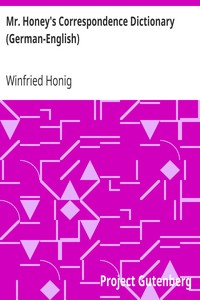
Mr. Honey's Correspondence Dictionary (German-English) by Winfried Honig
On the surface, Mr. Honey's Correspondence Dictionary by Winfried Honig is exactly what its title promises. Published in the mid-20th century, it's a functional guide designed to help German and English speakers write formal letters, from business inquiries to personal condolences. It provides templates, vocabulary lists, and etiquette tips for a world communicated through typed pages and postal stamps.
The Story
There isn't a traditional plot written by the author. The 'story' of this particular copy is one of accidental archaeology. The book is a time capsule of formal communication. But the magic happens in the handwritten layer added by an unknown reader. In careful script, this person has annotated the book—correcting a phrase here, questioning a translation there. Then, scattered amongst the practical notes, are personal jottings: a half-finished draft of a letter that was never sent, a phone number, a few melancholic lines in German about the weather, and several English words circled with intense focus, as if mastering them was a matter of great importance. Reading it feels like eavesdropping on someone's private struggle to bridge two worlds.
Why You Should Read It
This book captivated me because it's two experiences in one. First, it's a genuinely interesting historical document showing how people formally communicated across cultures before email. Second, and more powerfully, it's an intimate look at a stranger's mind. The annotations create a silent, one-sided conversation between the original author, the anonymous reader, and now, you. You start asking questions they can't answer. What was at stake for them? Was this book a key to a new job, a new country, a new life? The lack of answers is the point. It lets your imagination fill in the gaps, making you an active participant in uncovering the story.
Final Verdict
This is a niche pick, but a wonderful one. It's perfect for language lovers, history enthusiasts, and anyone who enjoys 'found object' stories. Don't go in expecting a novel. Go in expecting to find a puzzle in a thrift store, a personal connection with a stranger across decades. It's a quiet, thoughtful reminder that every book has two stories: the one printed on its pages, and the one written in the lives of the people who held it.
Legal analysis indicates this work is in the public domain. You can copy, modify, and distribute it freely.
William Garcia
10 months agoI was skeptical about the depth of this book at first, but it manages to maintain a consistent flow even when discussing difficult topics. It’s hard to find this much value in a single source these days.
Margaret Lopez
1 year agoThis work demonstrates a clear mastery of contemporary theories.
Elizabeth Lopez
1 year agoI found the author's tone to be very professional yet accessible, the way the author breaks down the core concepts is remarkably clear. It’s hard to find this much value in a single source these days.
Mary White
11 months agoI stumbled upon this title during my weekend research and the practical checklists included are a great touch for real-world use. It’s hard to find this much value in a single source these days.





Michael Lopez
11 months agoMy first impression was quite positive because the practical checklists included are a great touch for real-world use. It cleared up a lot of the confusion I had previously.