1

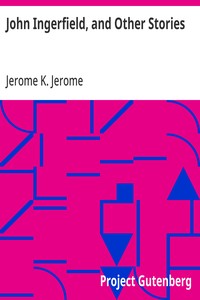
John Ingerfield, and Other Stories — Story, Setting & Ideas
(0 User reviews)
26
Project Gutenberg
2001
Not confirmed
Short stories; England -- Social life and customs -- 19th century -- Fiction
Readers of public-domain and historical texts
Project Gutenberg digital edition
en
Edition facts
Words
26,647
Reading time
116 min
Text sections
8
The source record for John Ingerfield, and Other Stories — Story, Setting & Ideas measures this digital text at 26,647 words, 1 hr 56 min estimated reading time, and 8 detected text sections.
The text analysis averages about 22.5 words per sentence, while the detected sections provide another way to judge how the source is divided.
Project Gutenberg metadata also associates the work with “Short stories,” connecting these edition facts with the source record’s subject description.
Source:
Project Gutenberg record #2525
Jerome K. Jerome's collection of five stories, including the title tale of old London and the eerie 'The Woman of the Sæter,' showcases his range from humorous patter to psychological suspense, with precise diction and atmospheric description.
Editorial Edition Score
4.6/5
★★★★★
★★★★★
Calculated from edition completeness, EPUB availability, text structure and catalogue metadata. Not a user rating.
How this score is calculated
- Description quality20 pts
- Title & short description10 pts
- Source metadata20 pts
- Text length15 pts
- Chapters / structure15 pts
- EPUB file integrity20 pts
Total of 100 points, scaled to a 2.5-5.0 range. Editions with an empty description or a missing EPUB file are not scored.
Edition quality
Public-domain source text
Read the source text
The source text is kept in the dedicated reader, separate from this catalogue record and its commentary.
Jerome K. Jerome opens his collection with a direct address to the reader and critic, explicitly marking three stories—'John Ingerfield,' 'The Woman of the Sæter,' and 'Silhouettes'—as not intended to be amusing. This authorial caveat signals a deliberate shift from the comic voice for which he was known, inviting attention to his handling of tone and genre. The remaining two items, 'Variety Patter' and 'The Lease of the Cross Keys,' he offers up to critics of 'the new humour.' The preface thus establishes a framework for reading the collection as a conscious exercise in stylistic range.
Diction and the Direction of Attention
In 'John Ingerfield,' Jerome uses an unusually elaborate, almost pedantic set of directions to guide the reader through East London: 'If you take the Underground Railway to Whitechapel Road... and from there take one of the yellow tramcars... until you come to where a railway arch crosses the road obliquely.' The sentence winds through multiple clauses, mimicking the physical journey while also establishing a narrator who insists on precise, almost bureaucratic detail. This diction contrasts sharply with the story's emotional core—a remembrance of a married couple—suggesting a tension between the chaotic urban setting and the private grief it contains. The specificity of 'three-ha'pence apiece' for pigs' trotters grounds the narrative in a particular economic reality, while the parenthetical 'or used to stand' hints at loss and change before the plot even begins.
Dialogue and the Unspoken
In 'The Woman of the Sæter,' dialogue is sparse and often replaced by reported thought or letters. The narrator describes a supernatural encounter through a series of letters, where direct speech is almost absent: the woman 'never spoke or moved, and neither did I feel the need of spoken words.' Instead, communication happens through gesture and silence—'she smiled at me—a strange, wicked smile.' The only spoken words implied are the tapping at the door, repeated three times ('tap, tap, tap'), which becomes a rhythmic motif. Jerome uses the epistolary form to create distance; the reader overhears a man trying to rationalize an experience he cannot fully articulate. The wife's few words—'She kissed me, though her lips were cold'—carry weight precisely because they are understated, leaving the emotional truth ambiguous.
Structure and the Framing of Unease
The collection's structure itself is a comment on authorial control. Jerome separates the stories into two categories: those he wishes to be judged 'from some other standpoint than that of humour' and those he surrenders to critics of the new humour. This framing creates an expectation of tonal whiplash. Within 'The Woman of the Sæter,' the narrative is broken into dated letters, each advancing the psychological deterioration of the writer. The first letter describes a sighting on a mountain; the second reports the woman's arrival at his door. The gaps between letters imply time passing and obsession growing. Jerome uses the letter form to withhold immediate resolution—the reader pieces together the narrator's descent from fragmentary evidence, much as the narrator himself tries to piece together whether the visitant is 'flesh and blood' or 'air.'
Recurring Details and Atmospheric Anchors
Jerome anchors his more unsettling stories in concrete, sensory details that recur with symbolic weight. In 'The Woman of the Sæter,' the kerchief left behind becomes an object of obsession: the narrator sees his wife later 'take the kerchief from a locked chest and look at it.' The kerchief is described as having been 'unwound from about her neck' and laid on the table—a domestic action that makes the supernatural intrusion tactile. Similarly, the 'bare feet... damp with the night dew' ground the apparition in physical reality. In 'John Ingerfield,' the 'soot-grimed church' and 'high flagstaff' with its 'elderly female purveyor of pigs' trotters' serve as mnemonic anchors for a lost London. These details are not merely decorative; they function as evidence the narrator clings to, even as the stories question the reliability of perception.
Readers attentive to Jerome's authorial choices will find a collection that resists easy categorization. The preface warns against reading for humour alone, and the stories reward attention to diction, narrative structure, and the weight given to objects and gestures. The excerpts suggest a writer experimenting with voice across genres, from the sentimental to the Gothic. Approach each story on its own terms, noting how Jerome shifts register between pieces, and consider how the framing of the collection itself shapes interpretation.
Something about Jerome’s quieter stories—the weight of old streets, that haunting woman in the snow—stayed with me long after. I kept thinking how a single face can hold an entire hidden story. It reminded me of the way I felt finishing A Face Illumined — Inside the Classic, that slow recognition of something familiar yet never fully seen. Some books just leave that hush behind.
There are no reviews for this eBook.
There are no comments for this eBook.
Reader reflection
Record your reading impressions
A brief reflection can help important ideas stay with you longer.
Your progress
0
/
10
2
How did the book work for you overall?
3
Is this a title you would suggest to others?
4
How demanding did the text feel?
5
How understandable was the text?
6
Would this book work well in a reading group?
7
How strongly did the book affect you emotionally?
8
Did the story or argument move comfortably?
9
Which lesson or insight stayed with you?
10